



- 5.0
The Highest-rated Car Rental Provider
The Highest-rated Car Rental Provider

Written By
Updated On 27 Jul 2026
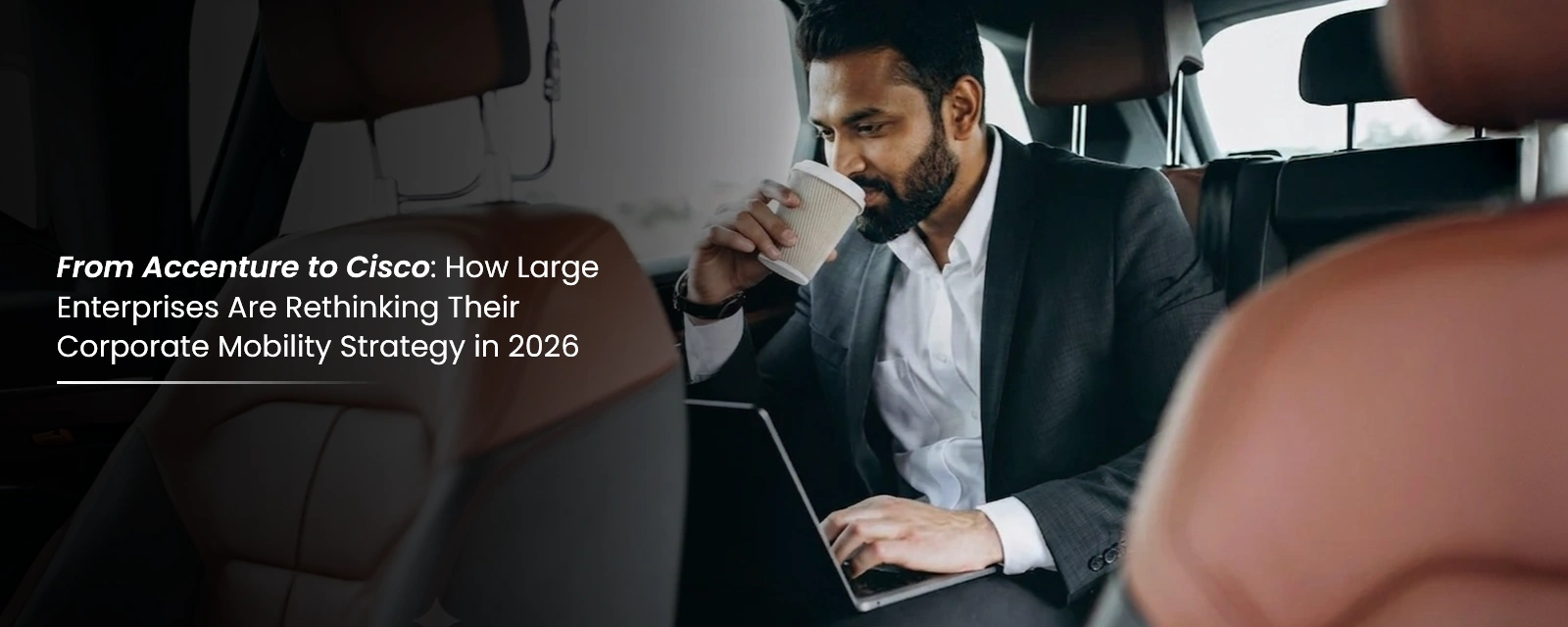
Discover how large enterprises are reshaping corporate mobility strategies in 2026 with safer, smarter, and technology-driven employee transportation. (148 characters)
Walk into the facilities or admin department of any large enterprise operating out of Gurugram's Cyber City or Bengaluru's Outer Ring Road corridor today, and you'll find a conversation that looks quite different from five years ago. It's no longer just "which cab vendor is cheapest." It's route optimization, ESG reporting, EV transition targets, and duty-of-care obligations, all bundled into what companies now call corporate mobility strategy rather than simply transport procurement.
Large enterprises, the kind with thousands of employees spread across multiple Indian cities, have been driving a lot of this shift, and smaller companies are increasingly following their lead.
The shift in language reflects a real shift in scope. A corporate cab service Gurgaon provider used to be evaluated almost entirely on price per kilometer and fleet availability. Enterprise mobility strategy today weighs a much broader set of factors: sustainability commitments (a growing number of large companies have public EV transition targets that extend to their vendor fleets), safety and duty-of-care standards (particularly for night-shift and women employees), data and reporting (finance and ESG teams increasingly want detailed trip-level data, not just monthly invoices), and vendor consolidation (fewer, more capable partners instead of a fragmented city-by-city vendor list). A modern corporate travel booking system now needs to capture ESG and utilization data alongside simple trip logs.
A growing number of large enterprises have committed to reducing the carbon footprint of their operations, and employee and executive transport is a visible, measurable component of that. This has pushed Employee Transportation service providers to expand EV offerings, not as a niche add-on but as a genuine fleet category companies actively request.
IP Travel Lines has responded to this shift by incorporating EVs like the Tata Nexon EV and MG ZS into its fleet mix, giving enterprise clients with sustainability targets a way to actually meet them rather than just report good intentions.
Large enterprises managing thousands of trips a month increasingly want granular visibility: which departments are generating the most travel spend, how utilization varies by city, whether SLA commitments are actually being met in practice rather than just on paper. This pushes vendors to build genuine reporting infrastructure rather than relying on manual invoice reconciliation, which was standard practice not that long ago.
Companies like Accenture, Cisco, and similar large employers with thousands of India-based staff have effectively set a bar that smaller companies now reference when evaluating their own vendors, even if their transport volume doesn't come close to the same scale.
The trend toward fewer, more capable vendor relationships (discussed at length in the broader shift away from city-by-city cab contracts) has only strengthened as enterprises scale. Managing fifteen different local vendors across fifteen offices was never efficient, but it's become genuinely untenable as reporting, safety, and sustainability requirements have grown more sophisticated. A single accountable partner is simply better positioned to deliver consistently against a complex, multi-dimensional set of enterprise requirements.
Enterprise-driven standards tend to trickle down. Mid-size companies increasingly find that the vendors capable of serving large enterprise accounts also bring better infrastructure, reporting, and safety standards to smaller clients, simply because they've had to build that capability for their bigger customers. This is generally good news: a rising standard across the industry benefits companies of every size, not just the Fortune 500 accounts driving the requirements initially.
IP Travel Lines has built its corporate offering around several of these enterprise-level expectations from the outset: 90 percent newer fleet vehicles, 100 percent in-house trained chauffeurs, transparent contract pricing, full insurance coverage, and an expanding EV fleet, delivered across 24 Indian cities under a single account structure. For companies evaluating whether their current vendor meets 2026 standards rather than 2020 ones, this is roughly the checklist worth running through.
Corporate mobility strategy in India is maturing quickly, pulled forward by large enterprises with the scale and scrutiny to demand more from their vendors. Companies still treating transport as a simple line-item procurement decision, rather than a genuine strategic function touching safety, sustainability, and employee experience, are increasingly out of step with where the market is heading.
Quick Booking Form

An in-house fleet costs more upfront and carries direct legal liability for acci...
previous post
Discover why premium ground transportation for C-level executives in India has e...
next postGrowing requirements around sustainability, safety, and data reporting have pushed transport from a simple procurement decision into a broader strategic function touching ESG, duty of care, and employee experience.
Yes, IP Travel Lines includes EVs like the Tata Nexon EV and MG ZS in its fleet, allowing enterprise clients with carbon reduction commitments to extend those targets to their ground transport.
Managing multiple fragmented local vendors across cities has become increasingly inefficient as reporting, safety, and sustainability requirements grow more sophisticated, making a single accountable partner more practical.
Generally yes. Vendors that build infrastructure and reporting capability to serve large enterprise accounts often extend those same standards to mid-size clients as well.
Fleet age and maintenance standards, chauffeur employment model, EV availability, transparent reporting capability, and multi-city consistency are all worth checking against current enterprise expectations.
 18 Sep 2026 | by IP Travels Lines
How to Book Reliable Cabs for Visiting F...
Booking transport for a visiting foreign delegate or board member carries more moving parts than a r...
Read Full Blog
17 Sep 2026 | by IP Travels Lines
In-House Company Fleet vs Outsourced Cor...
An in-house fleet costs more upfront and carries direct legal liability for accidents, maintenance f...
Read Full Blog 16 Sep 2026 | by IP Travels Lines
What Makes a Cab Service "VIP-Ready": Ch...
Plenty of companies advertise themselves as the best corporate cab company in delhi ncr, but the phr...
Read Full BlogSeamless Travel Solutions for Your Business. Let's Connect.



Seamless Travel Solutions for Your Business. Let's Connect.
Seamless Travel Solutions for Your Business. Let's Connect.