



- 5.0
The Highest-rated Car Rental Provider
The Highest-rated Car Rental Provider

Written By
Updated On 07 Jul 2026
Discover why dedicated executive travel in India offers C-suite leaders superior safety, comfort, punctuality, and professionalism over standard cab services.
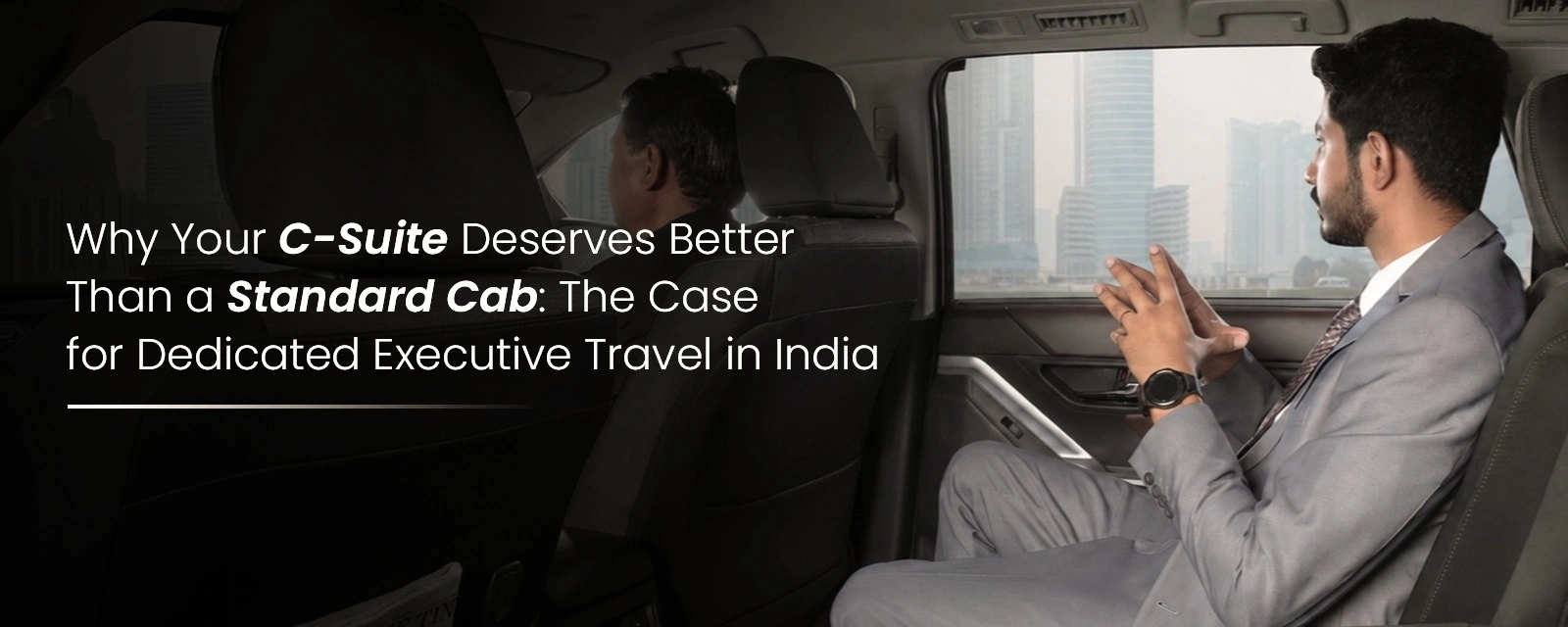
Picture this. Your CFO lands in Mumbai for a board meeting that decides next year's budget, and the car waiting for her is a scratched sedan with a driver who has no idea where the venue is. She walks in fifteen minutes late, a little frazzled, and the first impression of the day is already off. Small thing? Maybe. But small things add up fast when you're running a company.
That's really the whole argument for corporate cab services built specifically for leadership travel, not the general-purpose kind you'd book for an intern's airport run.
Most companies have some sort of travel policy. Fewer have actually thought through what changes when the passenger is a CEO, a visiting board member, or a client who could sign a seven-figure deal. There's an assumption that a car is a car. It isn't.
A regular ride-hailing app optimizes for availability. It wants a driver nearby, not necessarily one trained to handle a laptop bag with care, hold a door, or stay quiet through a call that shouldn't be overheard. That's where dedicated corporate travel management starts to matter. It's not about luxury for luxury's sake. It's about predictability, discretion, and a level of polish that matches the stakes of the meeting the person is heading into.
IP Travel Lines built its executive service around exactly this gap. Ninety percent of the fleet is newer vehicles, and every chauffeur is in-house and trained, not a freelance driver pulled from a random app queue. That distinction sounds small until you've had the other kind of experience.
A few things separate genuinely executive-grade transport from a nicer-looking cab.
Punctuality with a buffer, not just on time. Executives run on tight, overlapping schedules. A car that shows up "on time" but takes an unfamiliar route through traffic is still a problem. Good corporate travel companies in india track flight status, monitor traffic in real time, and build in a cushion so a late gate change doesn't cascade into a missed meeting three cities away.
Confidentiality as a default, not a request. Chauffeurs handling leadership travel are often present for calls involving sensitive numbers, upcoming hires, or unreleased strategy. That requires training, not just a signed NDA somewhere in a file.
Vehicle consistency. A visiting client shouldn't get a Fortuner one day and a battered hatchback the next. Fleet standardization, the kind where 90 percent of cars are recent models, signals that the company takes the relationship seriously.
A single point of contact. When something changes at the last minute (and with executives, it always does), someone needs to be reachable immediately, not buried in a support ticket queue.
There's a business case buried in here too. Client-facing transport is often the first and last physical touchpoint of a deal. A candidate flying in for a final interview forms an opinion about your company before they've even reached the building. A foreign delegate meeting your leadership team notices whether the ride matched the seriousness of the conversation.
This is why so many Fortune 500 and mid-size Indian companies have moved away from ad hoc bookings and toward structured accounts with a dedicated provider. It's less about status and more about risk management. One bad ride, one late arrival, one uncomfortable moment in traffic, and the tone of an important meeting shifts before anyone's said a word.
Finance teams sometimes push back here, and it's a fair instinct. Why pay more for a car? The honest answer is that dedicated executive transport usually isn't dramatically more expensive than piecing together ad hoc rides across a month, once you count the missed meetings, the reputational cost of a scruffy pickup, and the time HR spends managing complaints. Transparent, contract-based pricing (no surprise surge fees, no negotiating with a random driver) tends to be easier to forecast too, which finance teams generally appreciate more than they let on.
If your company still treats executive travel as an extension of the general employee cab pool, it might be worth separating the two. Not every ride needs white-glove treatment, but the ones involving your leadership, your biggest clients, and your most important guests probably do.
IP Travel Lines works with companies across Delhi NCR, Mumbai, Hyderabad, and 20-plus other Indian cities to set up exactly this kind of dedicated executive arrangement, with a consistent fleet, trained in-house chauffeurs, and a single account manager who knows the account instead of starting from scratch on every booking.
Your C-suite's time is expensive. The car that carries them should reflect that.
Quick Booking Form

A car is an unusual kind of confidential space, private enough that executives s...
previous post91457719031781397330.webp)
Corporate cab services streamline business travel with safety, reliability, cost...
next postThe main differences are chauffeur training, vehicle consistency, discretion, and a dedicated point of contact. Executive service is built around predictability for high-stakes travel, not just getting from A to B.
Not usually, once you factor in transparent contract pricing versus the hidden costs of surge charges, no-shows, and the reputational impact of an unprofessional pickup. Most companies find the difference smaller than expected.
Yes. Most corporate travel management providers, including IP Travel Lines, allow companies to tier their travel policy so leadership and VIP guests get a dedicated fleet while general staff use a separate, more cost-efficient option.
A few hours' notice is usually enough for providers with round-the-clock availability, though booking a day ahead gives more flexibility for flight changes and vehicle preferences.
Yes. IP Travel Lines currently serves 24 Indian cities including Mumbai, Hyderabad, Jaipur, Bengaluru, and Chennai, which matters for companies that need consistent executive transport across multiple offices.
 28 Sep 2026 | by IP Travels Lines
The Hidden Cost of Unreliable Executive ...
The direct cost of corporate cab services shows up clearly on an invoice. The indirect cost of unrel...
Read Full Blog 24 Sep 2026 | by IP Travels Lines
Corporate Chauffeur Service vs Ride-Hail...
A dedicated corporate chauffeur service offers trained, vetted chauffeurs with account-level account...
Read Full Blog 24 Sep 2026 | by IP Travels Lines
How to Book a Chauffeur-Driven Car for a...
Booking transport for a visiting CEO or foreign delegate starts with sharing the full itinerary and ...
Read Full BlogSeamless Travel Solutions for Your Business. Let's Connect.



Seamless Travel Solutions for Your Business. Let's Connect.
Seamless Travel Solutions for Your Business. Let's Connect.