



- 5.0
The Highest-rated Car Rental Provider
The Highest-rated Car Rental Provider

Written By
Updated On 18 Aug 2026
A patient flying into Delhi for a cardiac procedure is not thinking about ground transport until the exact moment it fails them. That is usually how this gap gets discovered, not through a planning meeting but through a stressful moment at the airport when a promised pickup does not show, or a wheelchair accessible vehicle was never actually arranged despite being requested weeks in advance. Medical tourism has grown into a genuinely large part of Delhi NCR's hospital economy, and the transport layer supporting it is still catching up to the volume. India's medical tourism market has been growing fast, with estimates putting it somewhere around thirteen billion dollars and climbing toward the seventies of billions over the next several years as more patients from Africa, the Middle East, Central Asia, and beyond choose Indian hospitals for cardiac care, orthopaedics, oncology, and transplant procedures at a fraction of what the same treatment costs back home. Delhi NCR's major hospital chains sit right at the center of this, and ground transport is quietly one of the make-or-break factors in whether a patient's experience feels reassuring or chaotic.
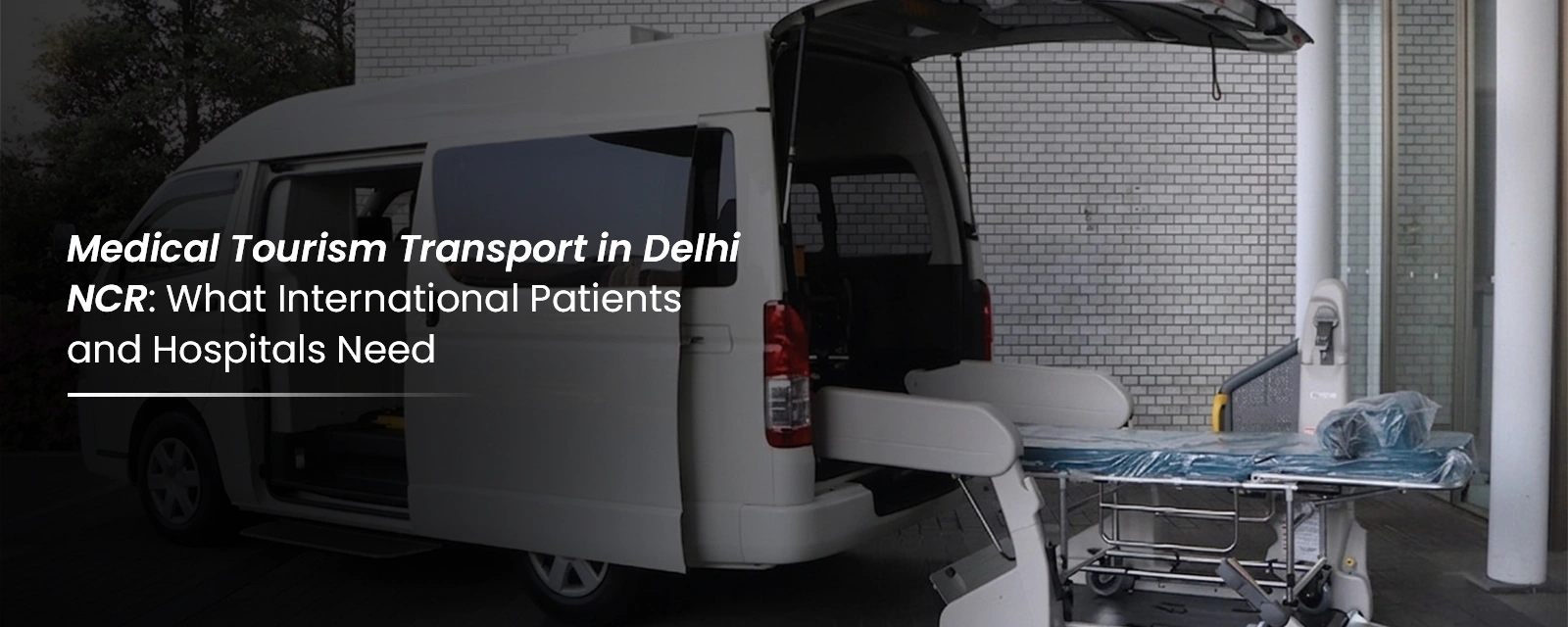
A patient arriving for major surgery, or being discharged after one, has fundamentally different needs than a business traveller. Bed to bed ambulance transfers require trained personnel who understand basic patient handling, not just a driver with a clean vehicle. Wheelchair accessible vehicles need to actually be wheelchair accessible, not just labelled that way on a booking form. Family members travelling alongside a patient are often exhausted, anxious, and navigating a foreign country's roads and language for the first time.
This is precisely why hospitals increasingly look for corporate cab services in delhi ncr that have a specific medical transport protocol built in, rather than treating patient transfers as just another airport pickup on the daily schedule. IP Travel Lines has structured part of its fleet and driver training specifically around this segment, recognising that a patient transfer needs a calmer, more careful driving style and a driver briefed on basic patient comfort considerations.
International patients typically land at IGI Airport and need to reach a hospital that could be anywhere from Gurugram to Noida to South Delhi, journeys that can run anywhere from roughly five to twelve US dollars in a standard transfer but carry far higher stakes when the patient is post-surgical, in pain, or requires monitoring equipment during the ride. A delayed or poorly coordinated pickup at this stage does not just inconvenience a tired traveller, it can genuinely affect a patient's condition and definitely affects their first impression of the entire hospital's care standard.
Hospitals that partner directly with a transport provider on booking corporate travel for their international patient coordinators get a meaningfully smoother handoff, because the transport team already has visitor flight details, medical requirements, and hospital coordination contacts on file rather than scrambling to arrange everything reactively when a patient's flight lands.
Most large Delhi NCR hospitals now run dedicated international patient services departments that handle visa assistance, translator coordination, and accommodation alongside medical care. Transport works best when it is looped into this department directly rather than booked separately by whichever family member happens to have local phone access. A transport partner with an established relationship to the hospital's IPD team can pre-schedule discharge transfers, arrange recurring transport for follow up visits during a patient's recovery stay, and coordinate directly if a flight or procedure timing shifts.
Despite the growth of medical tourism, ground transport in this space remains fragmented across many Delhi NCR hospitals, with some relying on informal driver networks that lack any real accountability if something goes wrong mid-transfer. Hospitals that have moved to a formal transport partnership report far fewer complaints reaching patient satisfaction surveys, largely because the entire chain from airport to bed becomes predictable instead of improvised.
Beyond basic reliability, hospitals evaluating a transport partner for their international patient program should ask about wheelchair accessible vehicle availability, driver training around patient handling, ability to coordinate multilingual communication where needed, and whether the provider can scale during high volume periods when multiple international patients arrive within the same week.
It is easy to focus purely on the patient and forget that most medical tourism trips involve at least one family member travelling alongside, often navigating an unfamiliar city for the first time while worried sick about a loved one. A transport partner who treats that family member with the same patience and clarity as the patient, explaining timings clearly, being available by phone, and never leaving anyone waiting without an update, ends up shaping how the entire trip is remembered long after the medical procedure itself is over. IP Travel Lines factors this into driver briefings for medical transfers, since a calm, communicative chauffeur genuinely reduces the anxiety of an already difficult journey.
Quick Booking Form

A car is an unusual kind of confidential space, private enough that executives s...
previous post
Noida does not get talked about as much as Gurugram when people discuss corporat...
next postPatients often require bed to bed handling, wheelchair accessible vehicles, and a calmer driving style, needs that standard corporate transport is not specifically trained to accommodate.
Estimates put it at roughly thirteen billion dollars currently, with continued strong growth projected over the coming years as more international patients choose Indian hospitals.
Flight details, medical requirements, discharge timing, and follow up visit scheduling should all be shared directly with the transport provider through the hospital's international patient department.
Post-surgical or unwell patients are more sensitive to delays and rough transfers, so a smooth, well timed pickup directly affects both comfort and the hospital's overall care impression.
Wheelchair accessibility, trained drivers familiar with patient handling, multilingual coordination ability, and enough fleet capacity to handle multiple simultaneous international arrivals.
 28 Sep 2026 | by IP Travels Lines
The Hidden Cost of Unreliable Executive ...
The direct cost of corporate cab services shows up clearly on an invoice. The indirect cost of unrel...
Read Full Blog 24 Sep 2026 | by IP Travels Lines
Corporate Chauffeur Service vs Ride-Hail...
A dedicated corporate chauffeur service offers trained, vetted chauffeurs with account-level account...
Read Full Blog 24 Sep 2026 | by IP Travels Lines
How to Book a Chauffeur-Driven Car for a...
Booking transport for a visiting CEO or foreign delegate starts with sharing the full itinerary and ...
Read Full BlogSeamless Travel Solutions for Your Business. Let's Connect.



Seamless Travel Solutions for Your Business. Let's Connect.
Seamless Travel Solutions for Your Business. Let's Connect.