



- 5.0
The Highest-rated Car Rental Provider
The Highest-rated Car Rental Provider

Written By
Updated On 21 Aug 2026
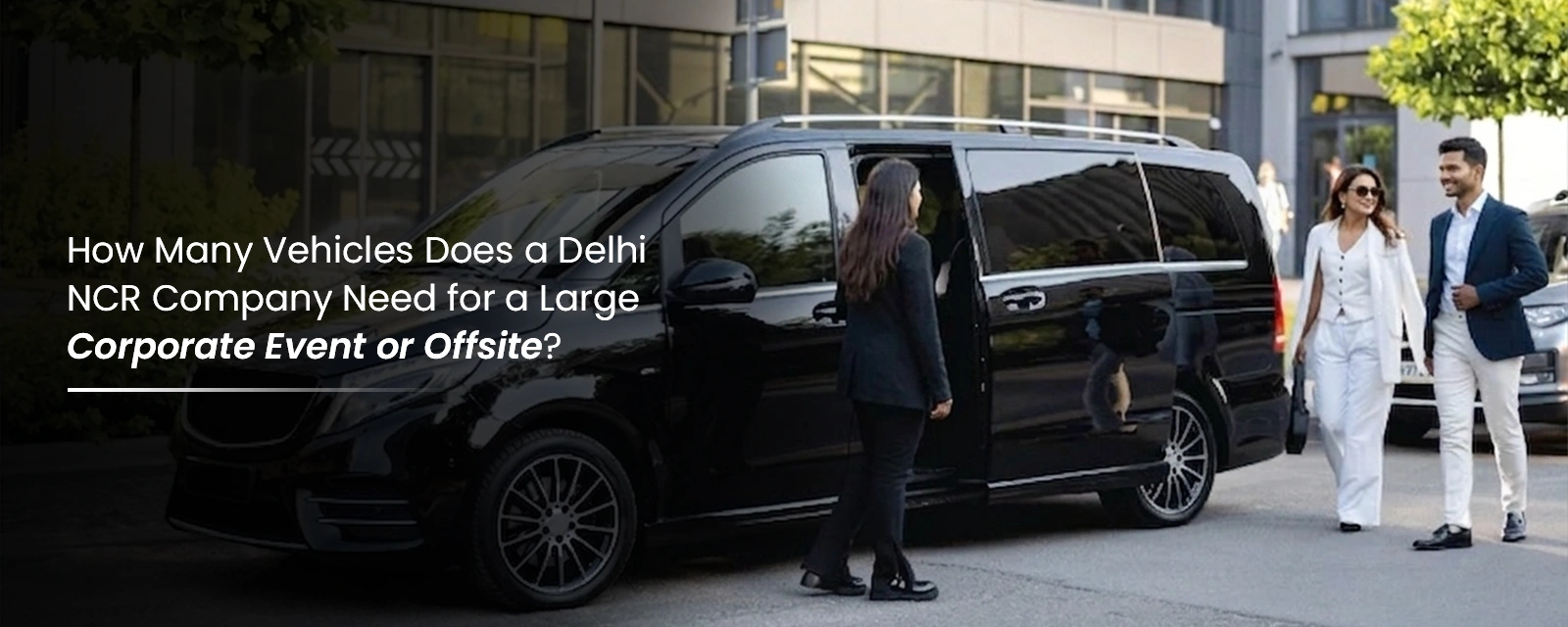
The rule of thumb most experienced transport planners use is roughly one vehicle per four to five attendees for sedan-based transport, or one coach per forty five to fifty people if switching to bus-based transport, plus a ten to fifteen percent buffer for contingencies. The right answer ultimately depends on group size, venue distance, and whether attendees are departing from a single point or multiple scattered locations across the city. Companies researching how to manage employee transportation for large companies in Gurgaon for a big event quickly discover that vehicle count calculations only get you halfway there. The real complexity comes from coordinating staggered departure points, matching vehicle type to distance and comfort needs, and building in enough contingency capacity that one delay or breakdown does not cascade into a scheduling disaster for the entire event.
Below roughly one hundred and fifty to two hundred attendees, a mix of sedans and SUVs usually remains manageable, especially if the group has varied pickup points across the city. Beyond that threshold, coaches start making dramatically more sense. Five hundred attendees in sedans means well over a hundred vehicles to coordinate, each with its own driver and route. The same group fits into roughly a dozen coaches, cutting convoy complexity enormously and simplifying arrival timing at the venue.
Large events rarely have every attendee departing from the same location. Some employees might leave from a South Delhi office, others from a Gurugram campus, and a smaller group flying in directly to the venue. Companies relying on booking corporate travel support for this kind of multi-point coordination need a transport partner who can sync timing across all pickup zones so the group converges at the venue within a reasonable window, rather than trickling in over several scattered hours.
Experienced event planners always add a buffer beyond the exact headcount calculation, typically ten to fifteen percent extra capacity to absorb last-minute attendee additions, a vehicle needing unexpected maintenance, or a pickup point running later than planned. Skipping this buffer is one of the most common and avoidable mistakes companies make when estimating transport needs for a large event.
A short intra-city transfer has very different comfort requirements than a two or three hour drive to a resort outside Delhi NCR. For longer journeys, coaches with proper luggage capacity and comfortable seating matter significantly more than they would for a quick airport run. Experienced corporate travel companies factor this distinction into their vehicle recommendations rather than defaulting to whatever is available.
If the event spans two or three days with excursions or return trips mid-event, the vehicle plan needs to account for this rather than treating transport as a single one-way drop. Keeping the same coach fleet available throughout the event, rather than releasing vehicles after the initial drop-off, adds flexibility that companies often only realise they need once the event is already underway.
IP Travel Lines treats large event transport as a single coordinated operation from the planning stage, mapping attendee pickup zones, calculating realistic vehicle counts with contingency buffer built in, and assigning route planning and convoy timing before the event date rather than improvising on the day. This upfront discipline is precisely what keeps a five hundred person offsite running smoothly instead of turning into a logistics headache midway through the day.
Companies frequently plan the outbound leg of an event carefully and then treat the return trip as an afterthought, which is exactly when things tend to go wrong. Attendees leaving a venue after a long day, or after an evening event with alcohol served, often depart in a less predictable, more staggered pattern than the outbound trip. Vehicle plans should account for this by keeping enough capacity available for a longer, messier return window rather than assuming the same tight schedule that worked in the morning will hold in the evening.
Even a well designed transport plan fails if attendees do not know which vehicle to board, when to be at the pickup point, or who to contact if something changes. Clear communication in advance, ideally through the same events or HR team coordinating the rest of the offsite, paired with visible signage or a coordinator physically present at pickup points, prevents the kind of confusion that makes a well planned transport operation look chaotic on the day even when the underlying logistics were solid.
Quick Booking Form

A car is an unusual kind of confidential space, private enough that executives s...
previous post
A chauffeur service provides trained drivers and vehicles for specific trips or ...
next postRoughly one vehicle per four to five attendees for sedans, or one coach per forty five to fifty people, plus a ten to fifteen percent contingency buffer.
Generally once attendee count exceeds around one hundred fifty to two hundred people, coaches become significantly more efficient than managing a large sedan convoy.
It absorbs last-minute additions, vehicle issues, or delayed pickups without disrupting the entire event schedule, which a bare-minimum count cannot accommodate.
A single coordinated transport provider should sync timing across all pickup zones so the group arrives at the venue within a reasonable window.
Yes, multi-day events with excursions need the same fleet kept available throughout, rather than a one-way drop that leaves attendees without local transport options. Companies that plan for this upfront avoid the scramble of arranging ad hoc local transport mid-event, which tends to be both expensive and unreliable when arranged reactively.
 28 Sep 2026 | by IP Travels Lines
The Hidden Cost of Unreliable Executive ...
The direct cost of corporate cab services shows up clearly on an invoice. The indirect cost of unrel...
Read Full Blog 24 Sep 2026 | by IP Travels Lines
Corporate Chauffeur Service vs Ride-Hail...
A dedicated corporate chauffeur service offers trained, vetted chauffeurs with account-level account...
Read Full Blog 24 Sep 2026 | by IP Travels Lines
How to Book a Chauffeur-Driven Car for a...
Booking transport for a visiting CEO or foreign delegate starts with sharing the full itinerary and ...
Read Full BlogSeamless Travel Solutions for Your Business. Let's Connect.



Seamless Travel Solutions for Your Business. Let's Connect.
Seamless Travel Solutions for Your Business. Let's Connect.