



- 5.0
The Highest-rated Car Rental Provider
The Highest-rated Car Rental Provider

Written By
Updated On 25 Aug 2026
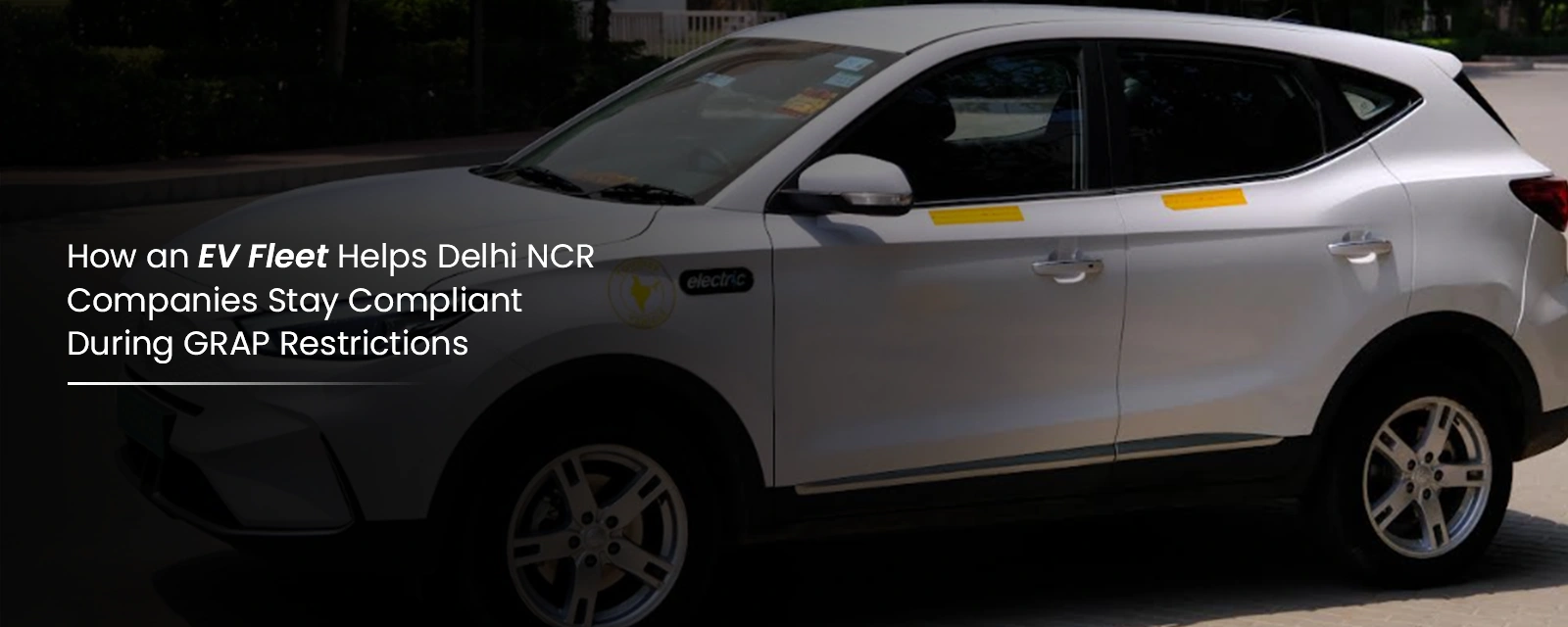
Every winter, roughly the same conversation happens in facilities and admin departments across Delhi NCR. Air quality drops, GRAP stages start kicking in, and suddenly someone is scrambling to figure out whether the company's contracted cabs are even allowed on the road that week. Companies that have not thought this through in advance tend to find out the hard way, usually on the exact morning a Stage 3 restriction gets announced and half their employee shuttle fleet is diesel vehicles registered outside Delhi. The Graded Response Action Plan, GRAP, is the framework Delhi NCR uses to escalate pollution control measures as air quality worsens, running from Stage 1 through the most severe Stage 4. The restrictions that actually bite for corporate transport usually start showing up at Stage 3, which limits non-essential construction and restricts BS-4 diesel light commercial vehicles registered outside Delhi from operating. Stage 4, triggered when AQI crosses roughly 450, goes further and bans BS-3 petrol and BS-4 diesel vehicles altogether except for those providing essential services.
The benefit is not just about avoiding a compliance headache, though that alone is significant. It is about operational continuity. Employee shuttles, executive pickups, and client transport all need to keep running regardless of what stage GRAP happens to be at on a given day. A fleet that includes a meaningful share of EVs and CNG vehicles gives a company genuine confidence that transport will not simply stop functioning during the exact weeks when Delhi's air quality is worst, which also happens to coincide with a busy period for many businesses heading into year end.
A properly structured Luxury cab company partnership does not mean every single vehicle needs to be electric, but it does mean the provider has enough EV and CNG capacity in reserve to reroute bookings during restriction periods without a company having to renegotiate terms or scramble for a backup vendor mid-crisis.
There is also a growing business case beyond pure compliance. Companies reporting on ESG commitments increasingly need to show progress on scope three emissions, and employee and executive transport is a visible, easy to communicate piece of that story. Being able to tell stakeholders that a meaningful share of contracted transport runs on electric vehicles is a small but genuine data point in broader sustainability reporting, and it is becoming a more common question in vendor RFPs than it was even two or three years ago.
The practical step most companies skip is simply asking their current transport vendor a direct question: what percentage of your fleet is EV or CNG, and how does that change during GRAP Stage 3 or Stage 4? Vendors who cannot answer specifically, or who quote a number that sounds suspiciously rounded, are worth pressing further on before the next pollution season arrives. It is a far better conversation to have in September than in the middle of a Stage 4 alert in December when options are limited and everyone else is asking the same question at once.
Companies negotiating annual transport contracts should consider writing GRAP contingency language directly into the agreement, specifying that the vendor guarantees a minimum number of compliant vehicles available during restriction periods. This shifts the planning burden onto the vendor, where it belongs, rather than leaving a facilities manager to discover the gap reactively once restrictions are already in effect.
A few years ago, EVs were often framed purely as a premium, slightly indulgent add-on for corporate fleets. That framing has shifted. With fuel price volatility and the very real operational risk of losing access to diesel vehicles mid-winter, the cost calculation now factors in business continuity, not just per-kilometre running cost. Companies that once dismissed EV inclusion as unnecessary are increasingly asking for it explicitly in vendor negotiations, and providers who built this capacity early are simply better positioned to answer that demand without a scramble. IP Travel Lines has treated its EV additions as core fleet infrastructure rather than a marketing checkbox, which is part of why it has been able to keep client operations running smoothly through recent winters without the kind of vehicle shortages that caught competitors flat footed
Quick Booking Form

A car is an unusual kind of confidential space, private enough that executives s...
previous post
Somewhere around the two hundred attendee mark, corporate offsite transport stop...
next postGRAP stages escalate based on air quality index readings, with Stage 3 restricting older diesel commercial vehicles and Stage 4 banning BS-3 petrol and BS-4 diesel vehicles when AQI crosses roughly 450.
Yes, electric and CNG vehicles are generally exempt from the vehicle-related restrictions imposed under GRAP Stage 3 and Stage 4.
Because a vendor without sufficient EV or CNG capacity may be unable to service bookings once GRAP restrictions escalate, leaving companies without transport during high-demand periods.
It provides a concrete, reportable data point on reducing transport-related emissions, which increasingly factors into stakeholder and vendor evaluation criteria.
Yes, specifying a guaranteed minimum of compliant vehicles during restriction periods shifts planning responsibility to the vendor and protects business continuity.
 28 Sep 2026 | by IP Travels Lines
The Hidden Cost of Unreliable Executive ...
The direct cost of corporate cab services shows up clearly on an invoice. The indirect cost of unrel...
Read Full Blog 24 Sep 2026 | by IP Travels Lines
Corporate Chauffeur Service vs Ride-Hail...
A dedicated corporate chauffeur service offers trained, vetted chauffeurs with account-level account...
Read Full Blog 24 Sep 2026 | by IP Travels Lines
How to Book a Chauffeur-Driven Car for a...
Booking transport for a visiting CEO or foreign delegate starts with sharing the full itinerary and ...
Read Full BlogSeamless Travel Solutions for Your Business. Let's Connect.



Seamless Travel Solutions for Your Business. Let's Connect.
Seamless Travel Solutions for Your Business. Let's Connect.