



- 5.0
The Highest-rated Car Rental Provider
The Highest-rated Car Rental Provider

Written By
Updated On 30 Jul 2026
Discover how employee transportation ROI boosts productivity, improves retention, reduces absenteeism, and creates a more efficient workforce.
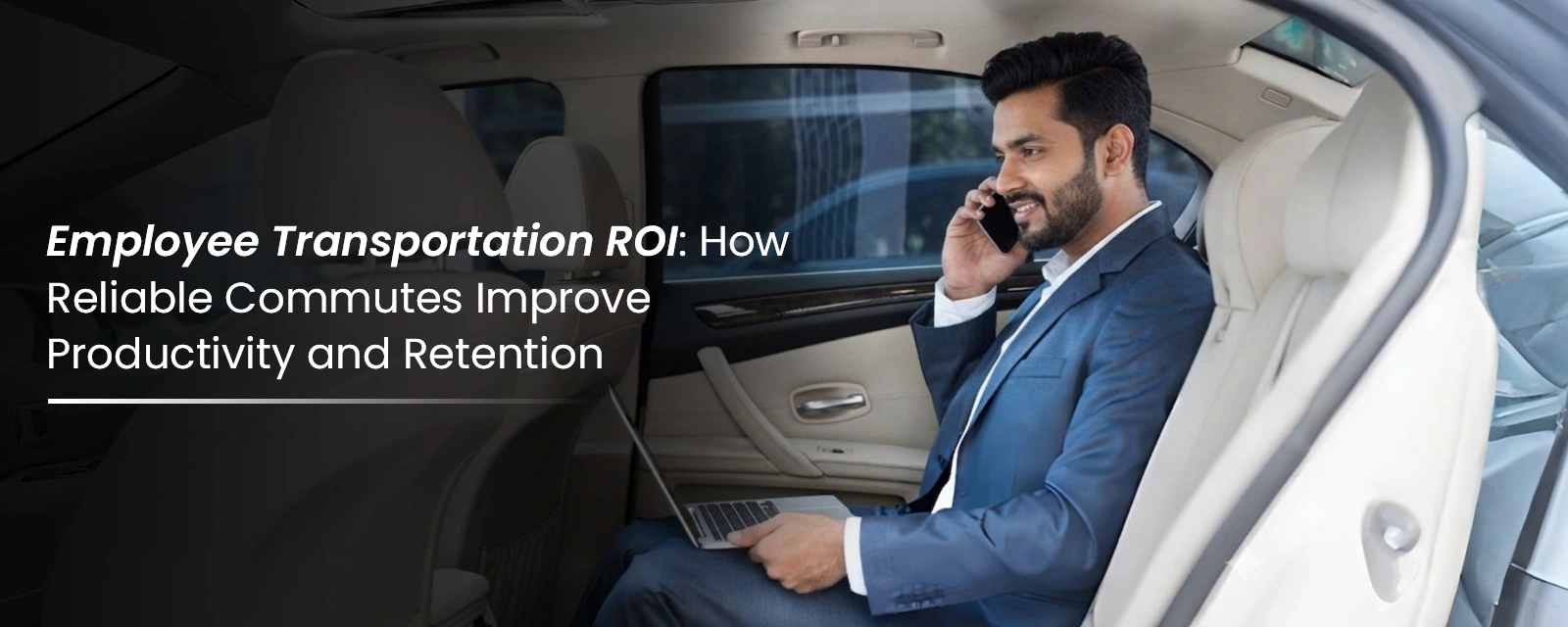
Reliable employee transportation improves ROI primarily through three channels: reduced lost work hours from late or unpredictable commutes, lower attrition among employees (especially night-shift and women staff) who might otherwise leave over safety or reliability concerns, and reduced administrative burden from managing complaints and ad hoc booking chaos. Companies that invest in structured transport programs consistently report measurable gains across all three, even though the ROI rarely shows up as a single clean line item.
Here's how each of these actually plays out in practice.
Unreliable commutes don't just cause occasional lateness. They create ongoing low-grade anxiety, employees checking driver location repeatedly before leaving their desk, arriving mentally frazzled rather than ready to focus, or losing meaningful chunks of a shift dealing with transport-related disruptions. Reliable, GPS-tracked, predictable transport removes this background stress, and the productivity gain, while hard to isolate precisely, shows up consistently in engagement surveys and manager feedback once companies make the switch.
While employee transportation ROI is mostly about volume programs, it's worth addressing a related question companies sometimes have: how to get a dedicated luxury car with driver for a week in Delhi, typically for a visiting executive or an intensive project engagement. This works through a short-term dedicated booking, usually arranged directly with a provider like IP Travel Lines, specifying vehicle preference, daily hours needed, and any specific requirements, priced as a weekly package rather than individual daily bookings. This kind of flexible, dedicated arrangement sits alongside broader ROI-focused employee transport programs as part of a complete corporate mobility strategy.
This is where the ROI case gets most compelling, even though it's the hardest to quantify precisely. Exit interview data across many companies consistently shows commute-related frustration as a contributing factor in attrition, particularly for night-shift and BPO roles where safe, reliable transport is close to a precondition for taking the job at all, not just a convenience.
Replacing a mid-level employee typically costs six to nine months of salary once recruiting, onboarding, and lost productivity during ramp-up are factored in. If unreliable transport is even a partial factor in a percentage of departures, the math around investing in a genuinely reliable Luxury Car Rental grade transport program starts looking very different from a simple line-item cost comparison.
Fragmented, unreliable transport generates a steady stream of admin overhead: complaint handling, ad hoc booking requests, invoice reconciliation across informal arrangements. A structured cab service for corporate employees program with clear SLAs and centralized booking removes most of this overhead, freeing HR and facilities time for higher-value work rather than firefighting transport complaints.
Companies serious about tracking this typically monitor a few indicators before and after implementing a structured program: on-time pickup percentage, employee satisfaction scores specific to transport, attrition rates among employees on shifts most dependent on company transport, and admin hours spent handling transport-related issues. The trend across these metrics, more than any single number, tells the real ROI story.
Transport often sits under facilities or admin budgets, competing for attention against more visible line items. Because its ROI is distributed across productivity, retention, and administrative efficiency rather than showing up as one clean number, it's easy for decision-makers to underestimate the actual value of getting it right, right up until attrition or productivity issues force a closer look.
IP Travel Lines structures its employee transportation programs around the fundamentals that drive this ROI directly: 100 percent in-house trained chauffeurs, GPS tracking, transparent pricing, and round-the-clock support, built specifically for companies that have recognized transport as a genuine productivity and retention lever rather than a background operational function.
Quick Booking Form

An in-house fleet costs more upfront and carries direct legal liability for acci...
previous post
Discover the top questions to ask a corporate transportation vendor before signi...
next postIt removes the background anxiety and lost focus time caused by unpredictable commutes, allowing employees to arrive ready to work rather than mentally exhausted from transport-related stress.
Yes, commute-related frustration appears repeatedly in exit interview data, particularly for night-shift and BPO roles where safe, reliable transport is close to essential rather than optional.
This is typically arranged as a short-term dedicated booking directly with a provider like IP Travel Lines, specifying vehicle type and daily hours, priced as a weekly package rather than daily bookings.
On-time pickup percentage, transport-specific satisfaction scores, attrition rates among transport-dependent shifts, and admin hours spent managing transport complaints all provide useful ROI signals over time.
Its benefits are distributed across productivity, retention, and administrative efficiency rather than appearing as one clear number, making it easy to undervalue compared to more visible budget line items.
 18 Sep 2026 | by IP Travels Lines
How to Book Reliable Cabs for Visiting F...
Booking transport for a visiting foreign delegate or board member carries more moving parts than a r...
Read Full Blog
17 Sep 2026 | by IP Travels Lines
In-House Company Fleet vs Outsourced Cor...
An in-house fleet costs more upfront and carries direct legal liability for accidents, maintenance f...
Read Full Blog 16 Sep 2026 | by IP Travels Lines
What Makes a Cab Service "VIP-Ready": Ch...
Plenty of companies advertise themselves as the best corporate cab company in delhi ncr, but the phr...
Read Full BlogSeamless Travel Solutions for Your Business. Let's Connect.



Seamless Travel Solutions for Your Business. Let's Connect.
Seamless Travel Solutions for Your Business. Let's Connect.