



- 5.0
The Highest-rated Car Rental Provider
The Highest-rated Car Rental Provider

Written By
Updated On 17 Jul 2026
Learn how a CEO's airport transfer reflects your company's professionalism, brand image, and executive travel standards for lasting impressions.
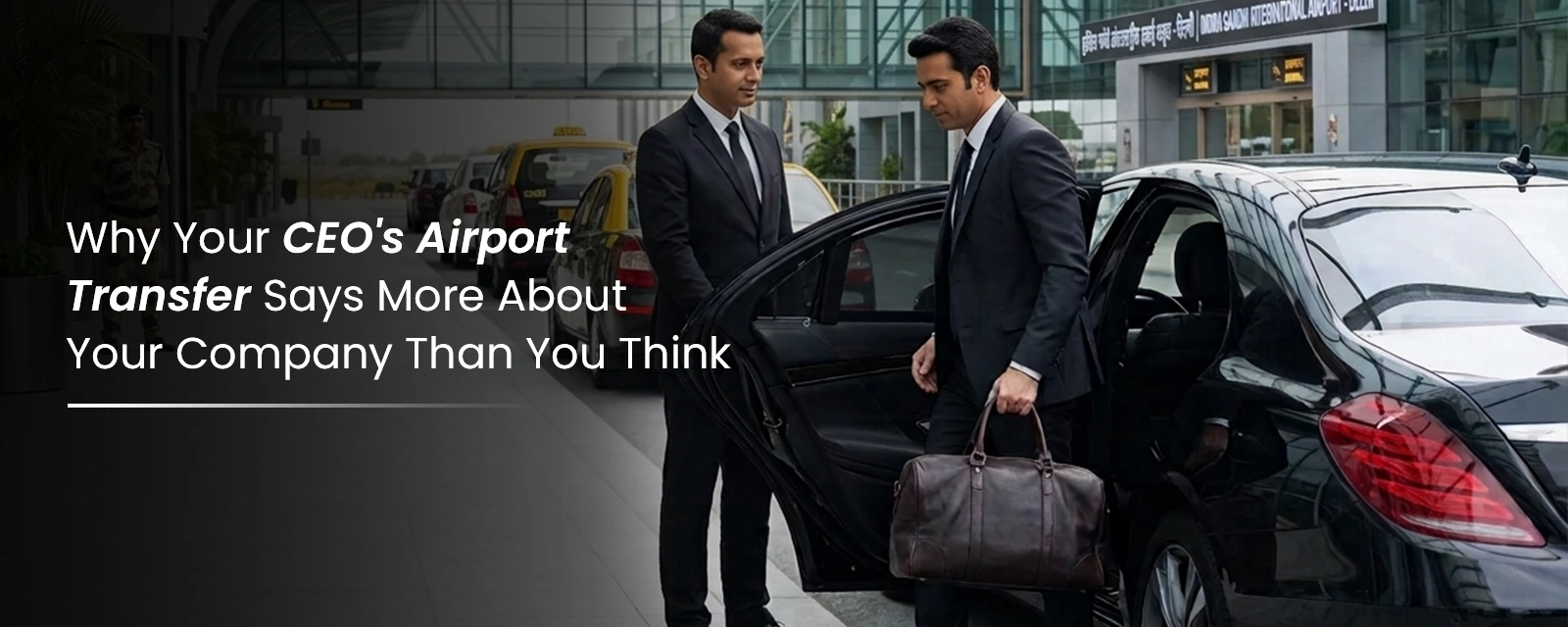
Think about the last time you picked someone up from the airport for a first date, or went to collect a friend visiting from abroad. You probably thought about what to wear, whether you'd be early, maybe even cleaned out the car beforehand. Now ask yourself honestly whether your company puts that same level of thought into how it picks up a visiting CEO, investor, or client from the airport.
Most companies don't, and it shows more than they realize.
There's a reason airport pickups carry disproportionate weight in how a visit gets remembered. It's the very first physical interaction someone has with your company on the ground, before the office tour, before the pitch deck, before anyone's said a single word about the actual business. Corporate Transportation Costs get scrutinized heavily by finance teams, but the ROI of getting this specific touchpoint right rarely makes it into the spreadsheet.
A smooth pickup, on time, in a clean and comfortable vehicle, with a chauffeur who knows exactly where they're going, signals competence before anyone's opened a laptop. A chaotic one, a late car, a confused driver circling the terminal, a vehicle that smells like the last passenger's lunch, signals something else entirely, whether that's fair or not.
Senior executives and investors travel constantly. They've experienced enough airport pickups across enough companies and countries to have a well-calibrated internal benchmark, even if they never say so out loud. A rough pickup doesn't usually get mentioned in the follow-up email. It just quietly lowers the bar for how seriously they take everything that follows.
This matters even more for international visitors landing in India for the first time, where jet lag, unfamiliar traffic patterns, and general travel fatigue make that first hour disproportionately influential on their overall impression of the trip.
The companies that get this right share a few consistent habits. They track the actual flight status in real time, not just the scheduled arrival time, so a delay doesn't leave a chauffeur waiting at the wrong moment or, worse, arriving late. They brief the chauffeur on who's being picked up and any specific preferences, rather than treating every pickup identically. And they build in a genuine buffer for immigration and baggage claim delays, especially at busier airports like Delhi's IGI or Mumbai's Chhatrapati Shivaji Maharaj International.
Corporate travel management done properly treats the airport transfer as a designed experience, not an afterthought bolted onto the trip itself.
One good pickup doesn't close a deal on its own, obviously. But across the lifetime of a business relationship involving repeat visits, consistency compounds. An investor who's picked up smoothly on every visit starts to associate that reliability with the company's broader operational discipline, fairly or not. It becomes a small, quiet data point in a much larger pattern of trust.
The reverse is true too. A company that gets the small logistics wrong repeatedly starts to raise subtle doubts about whether it can execute on the bigger things.
Companies serious about upgrading their airport transfer experience usually start with a few concrete moves. Assigning a dedicated, trained chauffeur pool for VIP and executive pickups, rather than pulling from the general employee transport fleet. Setting up flight tracking integration so the transport team knows about delays before the passenger even lands. And providing chauffeurs with a simple briefing sheet: name, photo if possible, preferred vehicle type, and any special notes.
IP Travel Lines structures its airport transfer service around exactly these details, with round-the-clock booking availability and in-house chauffeurs trained specifically for business and VIP pickups, rather than treating airport runs as a generic add-on service. As one of the established corporate travel companies in india serving 24 cities, IP Travel Lines applies this same standard to every account, not just its largest clients.
Airport transfers are usually one of the smaller line items in a corporate travel budget. They're also, disproportionately, one of the most visible. Getting this one thing consistently right is a relatively low-cost way to project the kind of operational polish that companies otherwise spend far more trying to communicate through branding and marketing.
Quick Booking Form

Companies typically arrange this through a dedicated corporate transport partner...
previous post
Manage corporate event logistics in India with ease. Learn how to coordinate 100...
next postIt's usually the first physical touchpoint a visitor has with a company, setting an early tone before any actual business discussion begins. A smooth experience signals competence, while a chaotic one raises subtle doubts.
IP Travel Lines tracks flight status in real time and adjusts pickup timing accordingly, so a delayed flight doesn't result in a chauffeur waiting at the wrong time or arriving late.
Ideally yes. A dedicated, trained chauffeur pool for VIP and executive pickups ensures a more consistent, polished experience compared to pulling from a general transport rotation.
Given immigration and baggage claim variability at major airports like Delhi and Mumbai, a buffer of 30 to 45 minutes beyond the scheduled landing time is generally advisable for international arrivals.
Not directly on its own, but consistent, reliable pickups build a quiet pattern of trust over repeat visits, which can influence how partners and investors perceive a company's broader operational discipline.
 29 Aug 2026 | by IP Travels Lines
A Procurement Manager's Checklist for Ev...
Procurement teams tend to approach vendor evaluation the same way regardless of category, get three ...
Read Full Blog 27 Aug 2026 | by IP Travels Lines
Diplomatic and VIP Protocol Transport: W...
Delhi is home to one of the largest concentrations of diplomatic missions anywhere in Asia, and with...
Read Full Blog 26 Aug 2026 | by IP Travels Lines
How Do Delhi NCR Companies Calculate ROI...
Companies typically calculate ROI on outsourced employee transportation by comparing the full cost o...
Read Full BlogSeamless Travel Solutions for Your Business. Let's Connect.



Seamless Travel Solutions for Your Business. Let's Connect.
Seamless Travel Solutions for Your Business. Let's Connect.